battle, landmark, Cold War
Turkish invasion of Cyprus
Turkish invasion of Cyprus was a battle fought in 1974 at Cyprus. Its exact site is not recorded; the atlas places it at Cyprus. It was part of Cyprus problem, which ran from 1955 to 1974.
See it on the globe Read the article
Where it sits in Cyprus problem
Record
| Date | 1974 (year precision) to 1974 | |
|---|---|---|
| Place | Cyprus 35.000N, 33.000E | |
| Kind | Battle, Cold War | |
| Territorial change | Turkey occupies 36.2% of Cyprus; Formation of the Autonomous Turkish Cypriot Administration | |
| Strength | Turkey: 40,000 troops; 160–180 M47 and M48 tanks; Turkish Cypriot enclaves: 11,000–13,500 men, up to 20,000 under full mobilisation; Total: 60,000 | Cyprus: 12,000; Small number of T-34 tanks; Greece: 1,800–2,000; Total: 14,000 |
| Casualties and losses | 1,500–3,500 casualties (estimated) (military and civilian) including 568 KIA (498 TAF, 70 Resistance); 2,000 wounded; 270 civilians killed; 803 civilians missing (official number in 1974) | 4,500–6,000 casualties (estimated) (military and civilian) including 309 (Cyprus) and 105 (Greece) military deaths; 1,000–1,100 missing (as of 2015); UNFICYP: 9 killed; 65 wounded |
| Commanders |
|
|
The ground today

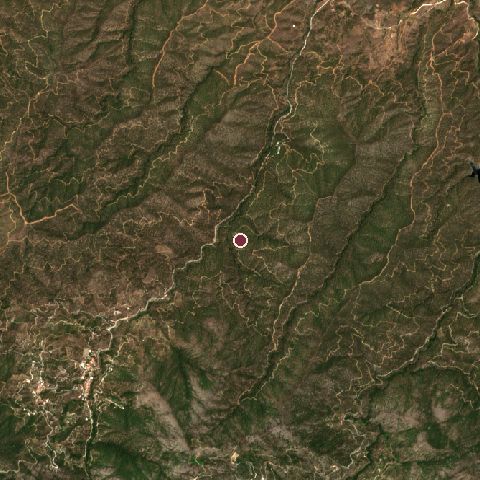
The recorded site stands at about 0 m; within 10.0 km the ground runs from 0 to 954 m, 954 m of relief, mountainous country and today it is 83% tree cover, 12% shrubland, 5% grassland.
Elevation from the Copernicus DEM GLO-30 (ESA, Airbus); land cover from ESA WorldCover 2021 (CC BY 4.0), within about 5 km of the recorded site. Computed, not recorded.Nearest engagements
- Battle of Agios Dometios 1974, 36 km NE
- Battle of Omorphita 1963, 40 km NE
- Battle of Tylliria 1964, 41 km NW
- Battle of Pentemili beachhead 1974, 44 km NE
- Siege of Kition 450 BC, 58 km E
In the same war
- Before: Battle of Agios Dometios 14 August 1974
- All 8 engagements of Cyprus problem
Elsewhere in 1974
- Battle of the Paracel Islands People's Republic of China
- 1974 White House helicopter incident United States
- Battle of Phuoc Long Vietnam
- military operations during the Turkish invasion of Cyprus Cyprus
- Battle of Kampot Cambodia
Turkish invasion of Cyprus is one of 4,429 engagements of the 20th century in the atlas and one of 31 in present-day Cyprus.
Sources
Identity, coordinates, dates and the war from Wikidata Q1050999, released under CC0. Result, belligerents, commanders, strength and casualties from the infobox of the English Wikipedia article Turkish invasion of Cyprus, revision 1385820233, read 2026-11-15, licensed CC BY-SA 4.0; the article's text is not reproduced here. Present-day country and state from Natural Earth. Dates before 1582 follow the Julian calendar as recorded.